AI Detection Guides
Is Winston AI Accurate?
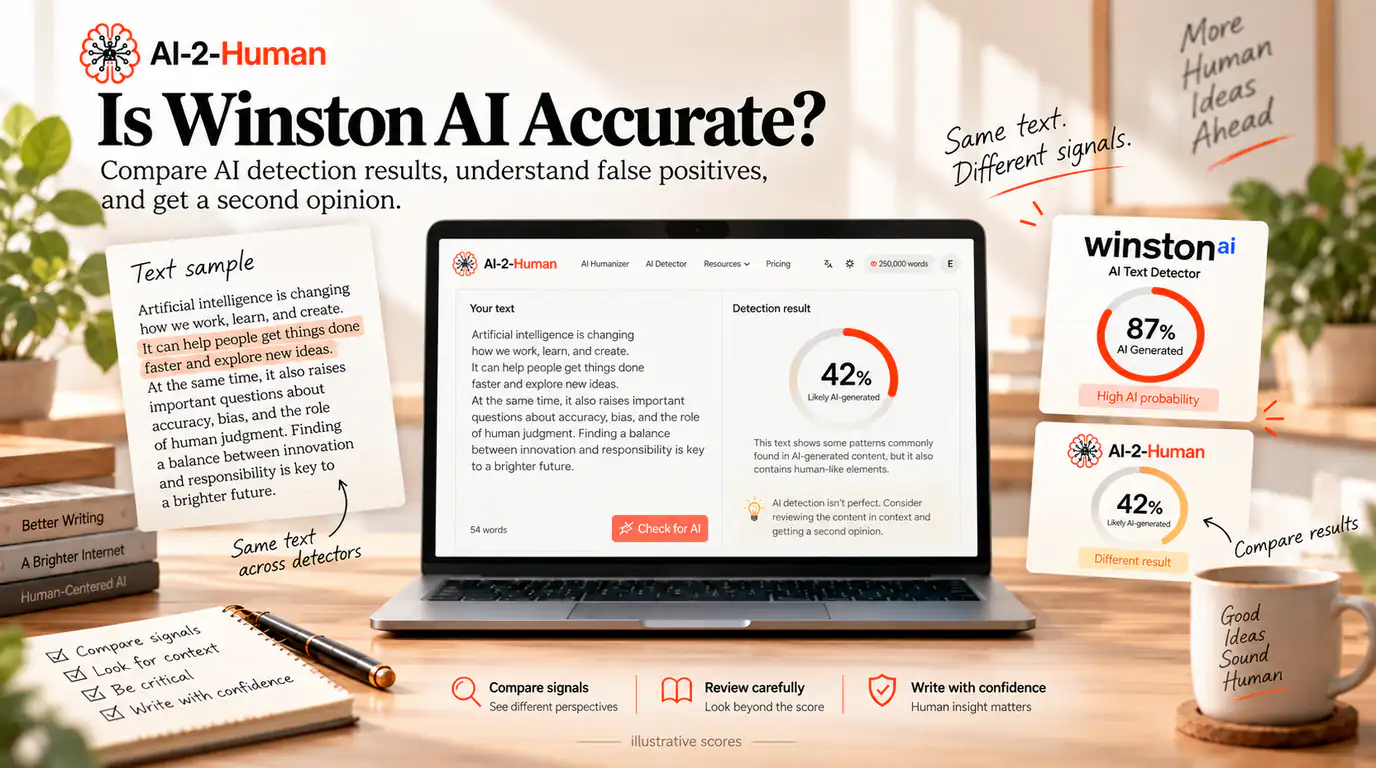
Winston AI reports very strong results for its current model, and the two independent studies on this page also found strong performance on their own datasets. That still does not make any detector right about every text. Winston calls its Human Score a prediction rather than a measurement of how much of a document was written by AI, and its own documentation lists the limits: short samples, heavily edited or translated text, bullet lists, code and tables all produce weaker signals. Text length, document type and model version decide how much a result is worth. When the outcome matters, treat a Winston AI score as one detection signal, compare the same passage with another detector, and read the highlighted passages yourself. AI-2-Human’s AI Detector gives you that second reading.
What is Winston AI?
Winston AI is an AI content detector. You paste a text or upload a document, and it returns a Human Score plus an AI Prediction Map that shows which passages pushed the result towards AI. Winston also lists the sections that had the strongest influence on the prediction and an explanation layer you can open for more detail. The wider product includes plagiarism-related checks and an API, which is why it is often used by schools, publishers and research teams rather than only by individual writers.
So, how accurate is Winston AI?
There is no single Winston AI accuracy percentage that applies to every text. What can be said is narrower and more useful: Winston reports very strong results for its current model on its own English evaluation set, an independent peer-reviewed comparison put it first on a small same-dataset test, and an applied medical-education study found it separated AI-written personal statements from classic human literature. Both independent datasets are small, and both describe the model version available at the time.
Winston’s own documentation frames accuracy the same way. It says strong detectors can be highly accurate while accuracy still varies by detector, model release, dataset, text length and document type, and it advises assessing a detector through independent research alongside transparent internal evaluation rather than a single headline percentage. The same help page ends with the sentence that matters most for anyone using these tools: no AI detector should be treated as an automatic guilty verdict.
- Model version: the Luka evaluations, the Curia evaluation and today’s model are different systems, and Winston dates each report.
- Dataset: a 10,000-sample English set, a 24-text comparison and 25 personal statements measure different things.
- Text length: Winston states that length is the single biggest factor, and short samples give the model less to work with.
- Document type: long-form prose works best, while lists, code, transcripts and boilerplate carry little usable signal.
- Editing and translation: heavy rewriting, humanizer tools and translation change the patterns the model reads.
- Metric: accuracy, sensitivity and false-positive rate are different numbers, and a win rate in a blind comparison is different again.
What Winston AI’s current model evaluation reports
Winston’s latest major release is Model 4.0, named Curia. Winston reports 99.95% overall classification accuracy on a 10,000-sample English dataset, an R² of 0.9908 when estimating the proportion of AI-generated text, and a human-writing accuracy of 99.97%, which corresponds to a 0.03% false-positive rate. The published Curia human-writing evaluation is dated February 5, 2025 and covers 10,000 human and machine samples, with human material drawn from varied sources and styles.
The previous release, Model 3.0, named Luka, documented a 10,000-text evaluation set split evenly between human writing produced before 2021 and AI-generated text, with a minimum sample length of 600 characters. Winston reports 99.98% AI detection accuracy, 99.50% human detection accuracy and 99.74% overall classification accuracy for that release, plus human-detection accuracy by document category: 100% for essays and theses, medical papers, movie reviews, speeches, Wikipedia articles and recipes, 99.56% for news and blog writing, and between 98.05% and 99.15% for fan fiction, Reddit posts, poems and Stack Overflow answers.
What independent research says about Winston AI
The main independent result is a peer-reviewed study published in Information Research in 2026 by researchers at the University of J.J. Strossmayer in Osijek. The paper, Verification of AI-generated content, analysed 24 texts written by three expert authors in English and Croatian, half human-written and half AI-generated, and ran them through four detectors: Winston AI, Originality.ai, ZeroGPT and Smodin. In the study’s standardized accuracy table, Winston recorded the highest average at 99%, ahead of Originality.ai at 98% and both ZeroGPT and Smodin at 91%.
Information Research: verification of AI-generated content (2026)
That is meaningful evidence, and it is also a small one. Twenty-four texts from three authors, in two languages, is a same-dataset comparison rather than a production benchmark, and the paper does not publish a version identifier for every detector or a sensitivity figure for each tool. The result supports the claim that Winston performs strongly on that test set. It does not establish that Winston is 99% accurate on your document.
The second independent study comes from medical education. Published in Cureus in 2025, it asked whether residency programmes can detect AI use in personal statements, and it analysed 25 writing samples of roughly 700 words each in November 2023 with three detectors: GPTZero, Undetectable AI and Winston AI. The samples included five AI-generated personal statements, five human personal statements written before ChatGPT existed, five written after it became available, and five excerpts from classic novels as a control. AI-generated work was identified as AI at high rates, classic literature was mostly read as human, and the real personal statements produced mixed results: across the three tools, human-written statements appeared to contain 64% to 100% AI content in the pre-ChatGPT group and 3% to 100% in the post-ChatGPT group.
Cureus: can residency programs detect AI use in personal statements? (2025)
That study is the most honest illustration of the problem. Same length, similar topic, same detectors, and a range that reaches a full false positive on writing a human being really did produce. Its authors warn that using validated tools badly can harm honest applicants. Winston’s library also documents a separate research use case: researchers from Yale, Northeastern University, the Chinese University of Hong Kong and City University of Hong Kong used Winston AI to analyse more than 1.1 million US consumer complaints. That is evidence of research adoption rather than an accuracy measurement, and it should not be read as a percentage.
What does Winston AI’s Human Score mean?
The Human Score runs from 0% to 100% and estimates how closely the complete document resembles verified human writing. Near 100%, the document strongly resembles human-written text. Near 0%, it strongly resembles AI-generated text. Near the middle, the result is less conclusive, and Winston lists the reasons: mixed authorship, heavy editing, too little text, translated material, or writing that does not push the model strongly in either direction.
The score is the primary result, and it is also a prediction rather than a measurement. Winston says this directly: the score does not mean that precisely 80% of the words were generated by AI when it reads 20% human. A low score is therefore not a count of machine-written words, and it is not a statement about who typed them.
Winston AI: how do we interpret the results from an AI text scan?
What is the AI Prediction Map?
The AI Prediction Map divides the document into smaller sections and colour-codes them to show which passages read as more human or more AI-like. Winston publishes five bands for the highlighted text: 0 to 20 as AI generated, 20 to 40 as likely AI, 40 to 60 as uncertain, 60 to 80 as mostly human, and 80 to 100 as human written.
Winston is explicit about how to use it. The map exists to locate passages worth reviewing, and sentence-level scores rest on much smaller samples than the document score, so they should not be read on their own or averaged into a conclusion. Formal language, repeated phrasing, boilerplate, quotations and a sudden change of style can all affect a single highlighted passage. The useful question is whether the pattern across the whole document matches the writing evidence you have, not whether one sentence was highlighted.
Can Winston AI flag human writing as AI?
Yes. A false positive is human writing read as AI-generated, and Winston acknowledges that detection is a prediction task in which false positives and false negatives are possible. Its published Curia evaluation reports a 0.03% false-positive rate, equivalent to 99.97% of verified human texts being correctly identified as human on a 10,000-sample English dataset, and the earlier Luka evaluation reported 0.50% on 5,000 verified human texts. Those are vendor evaluations of vendor-defined datasets, which is why the number should be read as a report rather than a guarantee.
Winston AI: false-positive rates and human-writing accuracy
The published category breakdown is more informative than the average, because it shows where the risk concentrates. In the Luka evaluation, human essays and theses, medical papers, movie reviews, speeches, Wikipedia articles and recipes were identified as human with 100% accuracy, while news and blog writing sat at 99.56% and Stack Overflow answers at 98.05%. Winston notes that the evaluation reports an aggregate result and does not publish separate false-positive rates for every writer group or document category, so a student writing in a genre that resembles published prose is in the well-performing part of the table, and a short unconventional sample is not.
Conditions that raise the risk are described consistently across detector documentation, and Winston’s own list is concrete: short snippets, bullet lists, transcripts, translated text, boilerplate legal language, tables and formulaic writing all sit closer to the boundary. None of that is evidence of AI use, and several of them are produced by careful, well-organised human writers.
Can Winston AI miss AI-generated text?
Yes. A false negative is AI-generated writing that reads as human, and Winston documents three situations that produce it. Heavily edited machine drafts can slide towards human: Winston states that significant human editing can lower the AI score even on AI-generated originals. Translated content is another, because translation alters writing patterns enough that results become less reliable. The third is mixed authorship, where a document combining human drafting and machine assistance produces a blended score that describes neither part well.
Paraphrasing and humanizing tools sit in the same zone, and Winston is unusually direct about it. Its documentation says that AI content run through a paraphraser or an AI humanizer will often score higher on the Human Score than unmodified AI output, that Winston is specifically trained to detect humanized content, and that heavy rewriting can nonetheless reduce the model’s confidence. It draws the conclusion this guide would draw too: a moderately elevated Human Score on paraphrased content does not prove that a person wrote the text.
Why Winston AI results can vary
Two people can run the same text and see different outcomes, and two detectors can disagree about one document. The explanation is usually in the conditions rather than in a fault.
- Model version: Winston’s own library documents at least two generations with different reported figures.
- Length: Winston calls length the single biggest factor, and short samples produce lower-confidence predictions.
- Document type: prose works best, while lists, code, tables, transcripts and boilerplate carry little signal.
- Editing history: heavy rewriting, paraphrasing and humanizer tools change the patterns the model evaluates.
- Language: Winston states that performance varies by language and by the training data available for it.
- Translation: translating a text rewrites its syntax and word choices, so the translated version can be read differently from the original.
- Mixed authorship: a document written by a person and then reworked with an assistant has no single true score.
Does text length affect Winston AI accuracy?
Winston says length is the single biggest factor in its results. A scan needs at least 500 characters, and the documentation recommends aiming for 300 words or more for a reliable score. Shorter snippets can still be scanned, but prediction confidence drops, and the overall Human Score stays more trustworthy than the sentence-level map, especially on short passages.
The practical rule is proportion. A full piece of writing where the same patterns repeat across several paragraphs carries more weight than a highlighted sentence, and Winston’s own example is blunt: a 50-word snippet may come back uncertain, while the same content expanded to 500 words produces a much more reliable score. If you only have a short extract, treat the result as provisional and scan the longest version you can.
Which types of writing work best with Winston AI?
Winston publishes a content-type table, and it is the most practical page in its documentation. Long-form prose performs best: essays, academic papers, blog posts and articles. Cover letters, personal statements, full email bodies, product descriptions and press releases are rated good, with the caveat that short samples reduce confidence. Social media posts, bullet-point lists, transcripts and translated content are rated limited, and source code, mathematical formulas, boilerplate legal text and tables are listed as not suitable, because they lack the prose characteristics the model relies on.
Winston AI: what types of content can I scan with Winston AI?
The table changes how an accuracy claim should be read. A document type in the top rows is where the published percentages come from; a bullet list, a translated page or a transcript is a different measurement with a much weaker signal, and a score from those categories says more about the material than about its author. The same page notes that mixed authorship produces blended signals, and that the Prediction Map is the tool for locating which sections drive the AI score in those cases.
How to interpret a Winston AI result
Winston’s own guidance is to start with the overall Human Score and then use the Prediction Map: the document score evaluates the whole text, while sentence-level scores are supporting context. Before acting on a result, these questions are worth a minute.
- How long is the sample, and is it prose or structured material?
- Is the overall Human Score clearly human, clearly AI, or near the uncertain middle?
- Which passages appear in the AI Prediction Map, and do they share a pattern?
- Does the highlighted text actually look unusual when you read it in context?
- Has the document been translated, paraphrased or heavily edited?
- Does another detector return a similar reading on the same text?
- Is there evidence of the writing process, such as drafts or a version history?
What a Winston AI result cannot establish on its own is worth stating plainly. It does not prove who wrote a document, whether AI use broke a policy, whether work was plagiarised, or whether anyone acted in bad faith. Winston says as much itself, describing a result as evidence to review and not as automatic proof of misconduct.
What to do if Winston AI flags your text
Work through the situation in a fixed order rather than rewriting on reflex. The sequence below takes a few minutes and applies to any detector.
- 1
Read the score in proportion
Check the sample length and whether the score is clear or near the uncertain middle.
- 2
Read the Prediction Map
Look at which passages were highlighted and whether they share a pattern.
- 3
Judge the writing itself
Ask whether the flagged sections really read as repetitive or mechanical.
- 4
Compare another detector
Run the same text through a second tool and see whether the readings agree.
- 5
Gather process evidence
Find drafts, version history or source notes if authorship is being questioned.
- 6
Revise only what needs it
Rewrite the passages that genuinely need improvement, and check citations separately.
Sometimes the concern is fair. Repeated sentence shapes, transitions that connect nothing and paragraphs that list claims without evidence are worth fixing whether or not a detector noticed them. When a passage really is mechanical, AI-2-Human Humanizer rewrites it into a more natural draft while keeping your meaning at the centre, and you edit the result in your own voice.
Should teachers or employers rely on Winston AI alone?
Not on its own. Winston’s documentation states that no detector should be treated as an automatic guilty verdict, and the Cureus study on residency personal statements shows why that wording matters: on genuine human writing, the three detectors it tested returned AI-content readings that reached 100% for some samples. A tool can be strong on the datasets where it is validated and still misread an individual document.
When authorship is contested, a process beats a number. Drafts, revision history, source notes, citations that can be checked, earlier work by the same writer, the assignment or workplace policy, and a conversation about the material all carry more weight than a percentage. A detector is most useful when it points to passages worth discussing, and least useful when it is asked to close the discussion.
Should you compare Winston AI with another detector?
Yes, especially when the result is borderline or consequential. Even strong detectors use different models, datasets and decision thresholds, so the same passage can be read differently by two tools. Winston’s own documentation makes the point in another way: it warns that metrics from different datasets are not interchangeable and should not be combined into a synthetic ranking, which is exactly why one percentage never settles a question about authorship.
A comparison helps in both directions. When two detectors flag the same passage, that passage is worth a careful read. When they disagree sharply, the disagreement tells you the text sits near a decision boundary and the score is soft, which is worth knowing before you rewrite anything or before someone else acts on the result.
Before you submit: a practical checklist
- I understand that Winston AI’s Human Score is a prediction, not a measurement.
- I checked whether the sample was long enough to be worth reading.
- I read the overall score before the individual sentence highlights.
- I looked at the AI Prediction Map in context rather than in isolation.
- I considered the document type and whether it is the kind of text the model handles well.
- I considered translation, paraphrasing or heavy editing.
- I compared another detector because the result matters.
- I looked for drafts or version history where authorship is in question.
- I revised only the passages that genuinely needed improvement.
Frequently asked questions
Winston AI reports very strong results for its current Curia model, including 99.95% overall classification accuracy on a 10,000-sample English dataset and a 0.03% false-positive rate, and a peer-reviewed 2026 comparison put it first on a 24-text same-dataset test. No detector is accurate for every text, though. Winston describes the Human Score as a prediction, and its own documentation lists the conditions where results are weaker.
It depends on the test. Winston reports 99.95% overall accuracy for Curia and 99.74% for the earlier Luka model, each on its own evaluation set. Independent evidence points the same way on small samples: 99% standardized accuracy in the Information Research 2026 comparison, and strong separation of AI-written versus classic human literature in a 2025 medical-education study that also produced mixed results on real personal statements. Different datasets, different answers.
It is a 0% to 100% estimate of how closely the complete document resembles verified human writing. Near 100% means it strongly resembles human writing; near 0% means it strongly resembles AI-generated text; near the middle the result is less conclusive. Winston describes it as the primary result and as a prediction rather than a measurement.
It means the model found patterns across the document that resemble machine writing. It does not mean that a specific share of the words was written by an AI: Winston states that a score of 20% does not mean precisely 80% of the words were generated. A low score is a signal to review, and a middle score often points to mixed authorship, heavy editing, translation or simply too little text.
No detector is, and Winston does not claim to be. Its documentation states that detection is a prediction task in which false positives and false negatives are possible, and that no result should be treated as an automatic guilty verdict. Its published false-positive rate for Curia is 0.03% on its own 10,000-sample English evaluation, which is a vendor measurement of a vendor-defined dataset.
Yes, false positives are possible. Winston’s documentation lists the situations where results are weaker: short snippets, bullet lists, transcripts, translated content, boilerplate, tables and formulaic writing. Its Luka evaluation also reports human-detection accuracy by category, with essays and theses, medical papers and several other genres at 100% and formats like Stack Overflow answers at 98.05%.
Usually because the model found regular, predictable patterns across the document rather than because anything improper happened. Formal register, repeated phrasing, boilerplate and a very short sample can all push a Human Score down. Compare another detector, read the highlighted passages in context, and revise only what genuinely needs it.
Check with the AI Detector →Yes. Winston documents three common causes: significant human editing, which can lower the AI score even on machine-generated originals; translation, which alters writing patterns; and mixed authorship, where human drafting and AI assistance blend into a middle score. Paraphrasing and humanizer tools sit in the same zone.
Winston is built to classify AI-generated text from major model families, and the Cureus study found that AI-generated personal statements written with ChatGPT were identified as AI at high rates, while classic human literature was mostly read as human. That does not mean every ChatGPT passage is flagged, or that a flagged passage proves ChatGPT was used.
Winston states that it is specifically trained to detect humanized content, and that AI text processed through a paraphraser or humanizer will often score higher on the Human Score than unmodified AI output, while heavy rewriting can reduce the model’s confidence. Its own conclusion is worth repeating: a moderately elevated Human Score on paraphrased content does not prove that a person wrote it.
Yes, and Winston calls length the single biggest factor. A scan needs at least 500 characters, and the documentation recommends 300 words or more for a reliable result. Shorter text can be scanned but prediction confidence drops, and Winston’s own example is that a 50-word snippet may come back uncertain where the same content expanded to 500 words would not.
Essays and academic papers are listed as the content type where Winston performs best, and the Luka evaluation reports 100% human-detection accuracy for human essays and theses. That describes long-form prose from that evaluation set. A short excerpt, a heavily edited draft or a translated essay is a different measurement with a weaker signal.
There is no permanent winner, because comparisons depend on the dataset, the model version and the metric. Winston reports strong internal results and led a small independent 2026 comparison, and it currently tops DetectArena, a crowdsourced blind comparison where it holds a 90.9% win rate and a 1821 Elo rating across 44 ranked battles. Winston’s own benchmark page is careful about what that means: a win rate measures which result users preferred when the detector names were hidden, not sensitivity or recall, and the platform sample at verification was 491 battles and 400 votes. Compare the two on your own text instead of assuming an order.
Compare with the AI Detector →On the datasets cited here, Winston has the stronger reported figures: it led the 2026 Information Research comparison at 99% against ZeroGPT at 91%, and it leads the DetectArena blind comparison by win rate, where ZeroGPT sits below it. Those are results about specific tests and their metrics rather than a permanent ranking. ZeroGPT’s own published behaviour and limitations are covered in our companion guide.
Yes, and it is expected rather than a sign that one of them is broken. Different models, datasets and thresholds mean the same passage can be read differently. Winston’s documentation warns that metrics from different datasets are not interchangeable, and the Cureus study measured exactly that kind of disagreement across three detectors on the same 25 samples.
Not as sole evidence. Winston states that no detector should be treated as an automatic guilty verdict, and recommends using its score alongside the source material, writing history and human judgement. For a high-stakes decision, combine it with drafts, revision history, citations that can be checked, earlier work by the same writer and a conversation about the material.
Yes, especially when the Human Score is borderline or the consequence is serious. A second reading shows whether the text sits near a decision boundary, and it gives you another set of highlighted passages to review. AI-2-Human’s AI Detector reads the same text with its own model so you can set two interpretations side by side.
Run the AI Detector →Yes. Paste the same passage into the AI-2-Human Detector and you get another reading of the text, with the sections that still look generated highlighted. If both tools point at the same passages, those are worth reviewing closely. If they disagree, you know the score is soft and can decide with more context than a single percentage provides.
Check my text →Sources & editorial notes
- Winston AI: research and validation library
- Winston AI: how do AI detectors work?
- Winston AI: how do we interpret the results from an AI text scan?
- Winston AI: what types of content can I scan with Winston AI?
- Winston AI: false-positive rates and human-writing accuracy
- Information Research: verification of AI-generated content (2026)
- Cureus: can residency programs detect AI use in personal statements? (2025)
AI-2-Human is not affiliated with or endorsed by Winston AI. Winston AI documentation, published model evaluations and the cited independent research were reviewed on September 20, 2026. Detector models and benchmark results change over time, so check the current Winston AI documentation before relying on any figure quoted here.
Updated