AI Detection Guides
Is Grammarly AI Detector Accurate?
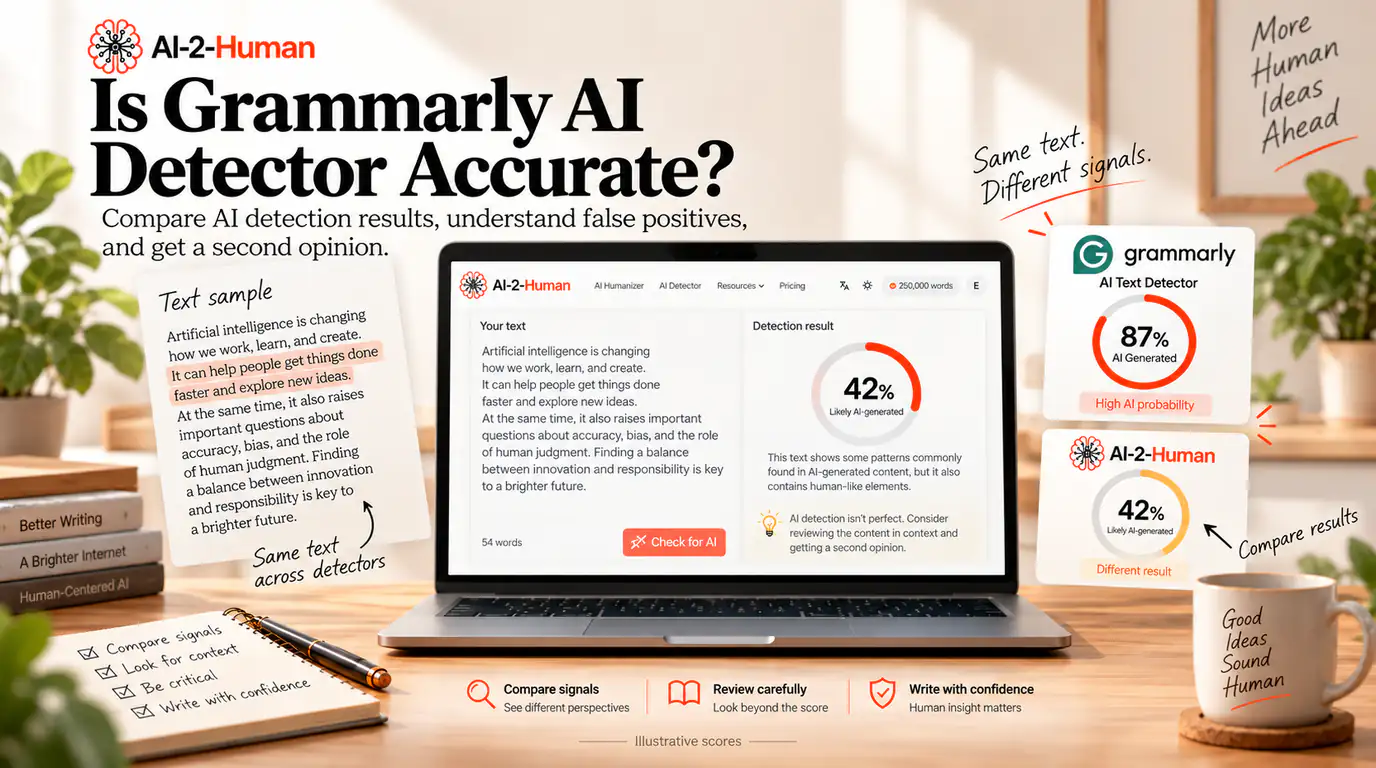
Grammarly’s AI Detector can perform very strongly on standardized benchmarks, but its score is not proof of how a document was written. Grammarly calls the percentage an averaged estimate of how much of the text looks AI-generated, states that the feature is not 100% accurate, and notes that shorter passages are harder to measure. Independent evidence points the same way: Grammarly performs well in a large shared benchmark, while a 2025 academic study recorded much lower percentages than another detector on identical AI-written introductions. The useful reading is that a Grammarly score is one detection signal. When the result matters, compare the same passage with another detector and read the flagged writing yourself. AI-2-Human’s AI Detector gives you that second reading.
What is Grammarly AI Detector?
Grammarly’s AI Detector estimates how much of a piece of writing looks AI-generated. Grammarly explains the mechanism in its own documentation: the text is broken into smaller sections, each section is checked against a machine-learning model for patterns typically present in AI text such as language patterns, syntax and complexity, and Grammarly then returns a percentage indicating how much of the text appears AI-generated. The model is described as trained on hundreds of thousands of human and AI-written texts.
The feature is not a separate website you visit once. Grammarly exposes it inside its product, including the AI Detector agent in its writing surfaces, the AI check inside Google Docs through the browser extension and the desktop applications for Microsoft Word, and it is a paid feature on most plans. A free version runs on the public AI Detector page, where you paste text or upload a document to see what percentage of it appears AI-generated.
So, how accurate is Grammarly AI Detector?
There is no single accuracy percentage that describes every Grammarly scan. What can be said is narrower and more useful: Grammarly’s detector separates AI-written from human-written text very reliably under benchmark conditions, and independent research shows the percentages it returns can sit well below the actual level of AI involvement.
Grammarly’s own wording sets expectations better than any third-party summary. Its user guide calls the score an averaged estimate of how much AI-generated text a document likely contains, says testing ensured the model is directionally accurate, notes that shorter passages are slightly harder to measure accurately than longer ones, and states that the feature is not 100% accurate and should not be used as a definitive assessment. A separate help article adds that no detector today can reliably and conclusively determine whether AI was used, and that these tools are a single data point rather than the sole source of evidence.
Grammarly: does using Grammarly trigger AI detectors?
- Writing style: formal, highly regular prose sits closer to the patterns detectors associate with machine writing.
- Text length: shorter passages are harder to measure accurately than longer ones, by Grammarly’s own account.
- Generating model: different language models leave different traces, and detectors are tuned on particular families.
- Human editing: text generated and then heavily rewritten no longer looks like raw model output.
- Mixed authorship: a document combining human drafting, AI assistance and manual revision is the hardest case.
- Detector version and dataset: Grammarly updates its model, and every published figure depends on the genre and length of the test material.
What does Grammarly’s AI percentage actually mean?
A score of 40% does not mean Grammarly has established that exactly 40% of a document was written by AI. It means the model found patterns across the scanned sections that make roughly that share of the text resemble AI-generated writing. Grammarly uses the words estimated and averaged deliberately, and repeats the qualification twice: the score should be viewed as an average estimate rather than a definitive percentage assessment, and it should not be used as an objective source of truth, because AI detection of any kind can be prone to errors.
The section-based design explains part of the ambiguity. Scanning in smaller sections shows which parts drove the result, but one percentage then compresses several local judgements into a single number: a document with three formulaic paragraphs and four personal ones can land on a middling score that describes neither half well.
What the RAID benchmark reports about Grammarly
RAID is a shared benchmark built to evaluate detectors under common conditions: over 10 million documents spanning 11 language models, 11 genres, four decoding strategies and a set of adversarial attacks including paraphrasing, synonym swaps and homoglyphs. Every participating detector is scored on the same material with the same evaluation script, which makes it the fairest public comparison available and the hardest to turn into a promise about one essay.
RAID: a shared benchmark for robust evaluation of machine-generated text detectors
Grammarly advertises its performance on that benchmark directly. Its AI Detector product page states that the product achieves 99% detection accuracy and ranks first on RAID’s independent benchmark, outperforming other leading AI detectors. That is a vendor claim, published by the company whose detector it describes, and it should be read as one.
Grammarly: AI Detector product page
The leaderboard itself is more specific. The snapshot cited here was taken on September 20, 2026, and Grammarly’s entry is dated 9 February 2026. Entries are submitted by detector developers and scored with the benchmark’s own script, so the conditions are shared while the submission comes from the vendor. In that snapshot Grammarly reports an AUROC of 0.9987 across all RAID conditions including adversarial attacks, with 99.47% accuracy at a target 5% false-positive rate and 98.21% at 1%. On the non-adversarial portion of the dataset, the same entry reports an AUROC of 0.99972 and 99.91% accuracy at a 5% target false-positive rate.
The metric names matter. AUROC measures how well a detector separates the two classes across every possible threshold, where 1.0 is perfect, and it is not a percentage of correct decisions. RAID’s accuracy figure is measured at a fixed operating point, the threshold where only 5% or 1% of the human-written texts are wrongly flagged.
What independent research says about Grammarly
The most useful independent result for Grammarly comes from a peer-reviewed study published in Advances in Simulation in 2025. The researchers took 30 open-access articles published before 2022 in two healthcare simulation journals, extracted the introductions and produced five versions of each: the human original, a lightly AI-edited human version, a heavily AI-edited human version, a version generated from human bullet points, and a version written entirely from the article title. Three free detectors (ZeroGPT, Phrasly AI and Grammarly) and five blinded human raters scored the same material.
Grammarly distinguished the five conditions overall, with a statistically significant effect and an effect size of 0.75, but its absolute percentages sat far below the level of AI involvement in the text. On the same introductions it averaged 1.6% on the untouched human text (95% confidence interval 0.0 to 3.1), 3.0% on light AI editing, 11.5% on heavy AI editing, 62.5% on text generated from bullet points and 50.0% on text written entirely by AI from the article title. ZeroGPT averaged 6.5%, 20.2%, 43.1%, 89.9% and 92.5% on the same five conditions.
Two conclusions follow, and they pull in opposite directions. The encouraging one is that Grammarly’s ordering was right: its scores rose as AI involvement rose, and it was the least likely of the three tools to flag untouched human writing. The cautionary one is that a document written entirely by a language model still came back at 50% on average, which is a long way from what a reader would call machine-written.
The study also measured how much the tools agreed with each other. ZeroGPT and Phrasly agreed very well, at 0.96. Grammarly’s agreement with ZeroGPT was only moderate, at 0.60, with a bias of 24.7 points, meaning ZeroGPT systematically returned higher AI percentages on the same material, and Phrasly against Grammarly came in at 0.57. The human raters did not do better: their overall accuracy across the five conditions was 19%.
Can Grammarly flag human writing as AI?
Yes. A false positive is genuinely human-written text that a detector reads as AI-generated or AI-assisted, and Grammarly acknowledges the case rather than ruling it out. Its documentation states that the model is optimised to minimise false positives, that there may be instances where human language patterns, syntax and complexity mirror AI-generated text more closely, and that it expects those instances to be very rare. The company then gives the same advice this guide gives: read the result in a broader context rather than as an objective source of truth.
The conditions that raise the risk are described consistently across the detector literature, and they are properties of writing rather than a checklist Grammarly publishes. Highly formal register, repetitive sentence structure, predictable transitions, low lexical variation, very short samples, genres far from a detector’s training data and English written as an additional language all sit closer to the boundary. None of these is evidence of AI use, and several are the product of careful writing.
Can Grammarly miss AI-generated text?
Yes, and the 2025 study is the most concrete public example: text written entirely by AI from an article title averaged 50.0% on Grammarly while the same material averaged above 92% on the other two tools. That result should not be turned into a failure rate, because it describes 30 introductions in one discipline, generated with one model family, at one moment in time. It does show the shape of the problem: a detector tuned to avoid false positives will let a share of machine-written text through.
Grammarly’s documentation explains why a rewrite can slip past. Its model is trained on human-written and AI-generated text from language model providers, and grammar or clarity suggestions typically do not change the percentage, while meaningful rewriting by a generative model raises it. Text generated and then edited by hand sits between those two cases, and so does a passage written by a person and then heavily rewritten by an assistant, which is the mixed authorship case no detector handles cleanly. Newer language models make the problem harder over time, because detectors are trained against the outputs that existed when the model was built.
Why Grammarly AI detection results can vary
When two people run the same text through the same tool and get different numbers, or when two tools disagree about the same document, the explanation is usually in the conditions.
- Detector version: Grammarly updates its model continuously, so results move as the product changes.
- Length and granularity: the text is scanned in sections, so a short document is judged on fewer local decisions.
- Editing history: grammar and clarity corrections usually leave the score alone, while generative rewriting raises it.
- Threshold and comparison: where a detector draws the line matters, and Grammarly says its scores differ from Turnitin, GPTZero, Copyleaks and others.
A percentage is only interpretable next to a description of the text it describes. Two sentences pasted from a paragraph, a full essay written in one sitting and a report assembled over three weeks with an assistant are three different measurements, even when the tool prints the same style of score.
Does text length affect Grammarly’s AI score?
Grammarly says so directly: shorter passages are slightly harder to measure for an accurate score than longer passages. That is a sensible statement about evidence, because a detector that analyses text in sections has fewer sections to work with when you give it two sentences, so its judgement rests on less material.
The practical rule is proportion. A high percentage on a full document, where the same patterns repeat across several paragraphs, deserves more attention than a high percentage on a single highlighted sentence. If you are checking something short, treat the result as provisional and check more of the text.
Does editing or paraphrasing change a Grammarly score?
Grammarly draws a line inside editing, and it is a useful one. Traditional, non-generative corrections such as grammar, clarity, word choice and concision suggestions typically do not affect the AI percentage, because they do not change the underlying language patterns the model reads. Rewriting sentences or whole paragraphs with a generative assistant is a different operation: Grammarly states that meaningful rewriting with its agent, its generative assistant or a paraphraser will raise the score, and that text generated by an outside provider is more likely to be assigned a higher percentage still.
The company applies that logic to its own tools, which is unusually candid. Its documentation warns that rewriting content with Grammarly’s rephrasing or humanizing agents will likely get the result flagged as AI-generated, because those rewrites come from Grammarly’s own language model, and suggests using agents for feedback you incorporate manually if being flagged is a concern. If you are reading someone else’s score, the same fact matters in reverse: text that has passed through a paraphrasing tool is harder to interpret, and a low percentage does not prove that no assistant was involved.
Grammarly AI Detector vs Grammarly Authorship
Grammarly ships two different ideas under similar names, and confusing them is the fastest way to misread a result. AI detection examines the finished text and estimates how much of it resembles AI-generated writing. Authorship records how the document was created, categorising text as it is entered: typed directly into the document, pasted from a browser-based source, pasted from an unknown source such as a private browsing window, generated by AI, or typed by the user and then modified with on-demand AI rephrasing.
Grammarly: Introducing Authorship
Authorship tracking works inside Google Docs through the browser extension and inside Microsoft Word through the desktop application, and it produces shareable reports that can include AI and plagiarism checks on higher plans. The distinction that matters for accuracy is simple: a detector reads the text and estimates, while an authorship record describes the process that produced it.
How to interpret a Grammarly AI score
Before you act on a percentage, run through the questions below. They are the difference between reading a signal and treating a number as a verdict.
- How much text was analysed: a full document or a short extract?
- Is the passage heavily edited, AI-assisted or a mix of both?
- Which sections were flagged, and do they share a pattern?
- Does the writing genuinely read as repetitive or formulaic?
- Does a second detector return a similar reading?
- Is there process evidence such as drafts, version history or an Authorship report?
What a Grammarly score cannot establish on its own is worth stating plainly. It does not tell you who wrote a document, whether AI use broke a policy, whether work was plagiarised, or whether a student is being honest. Grammarly says as much itself, describing its detection as a single data point rather than the sole source of evidence.
What to do if Grammarly flags your text
Work through the situation in a fixed order rather than rewriting on reflex. The sequence below is the same one this guide recommends for any detector, and it takes a few minutes.
- 1
Read the flagged passage
Judge it as writing first, and ask whether it actually reads as repetitive or formulaic.
- 2
Check the sample size
Was the score produced from a full document or from a couple of sentences?
- 3
Compare a second detector
Run the same text through another tool and see whether the readings agree.
- 4
Gather process evidence
Find drafts, version history or an Authorship report if authorship is being questioned.
- 5
Revise what needs it
Rewrite only the passages that genuinely need improvement, and verify citations separately.
Sometimes the concern is fair. Repeated sentence shapes, transitions that connect nothing and paragraphs that list claims without evidence are worth fixing whether or not a detector noticed them. When a passage really is mechanical, AI-2-Human Humanizer rewrites it into a more natural draft while keeping your meaning at the centre.
Should you compare Grammarly with another AI detector?
Yes, and here the recommendation comes from the vendor too. Grammarly’s documentation states that its detection uses a proprietary in-house model, that scores may differ from other solutions such as Turnitin, GPTZero and Copyleaks, and that its score should not be read as a clear indication that another detector will report the same thing. The independent study measured the same effect: 0.60 agreement between Grammarly and ZeroGPT on identical texts, with a gap of about 25 points between them.
A comparison helps in both directions. When two detectors flag the same passage, that passage is worth a careful read. When they disagree sharply, the disagreement tells you the text sits near a decision boundary and that the percentage is soft, which is worth knowing before you rewrite anything or before someone else acts on the result.
AI-2-Human’s AI Detector reads the same passage with its own model and points to the sections that still look generated, so you can set two interpretations side by side. It is a second opinion rather than an appeal to a higher authority: the point is to give you more to reason with before you decide what, if anything, to change.
Before you submit: a practical checklist
- I understand that Grammarly’s percentage is an estimate, not a measurement.
- I checked whether enough text was analysed before reading the score.
- I read the passages that triggered the flag instead of the headline number alone.
- I considered whether the text is human writing, AI-assisted writing or a mix of both.
- I compared another detector when the result actually matters.
- I looked for drafts, version history or an Authorship report where authorship is in question.
- I verified citations and facts separately from AI detection.
- I revised only the passages that genuinely needed improvement.
Frequently asked questions
Grammarly’s AI Detector performs strongly on standardized benchmarks: its own RAID entry reports an AUROC of 0.9987 and 99.47% accuracy at a 5% target false-positive rate in the snapshot we checked. No detector is accurate for every text, though. Grammarly describes its score as an estimate rather than definitive proof of AI use, and independent research shows the percentages it returns can sit well below the actual level of AI involvement.
The honest answer is that it depends on the test, which is why published figures differ so much. On RAID, a large shared benchmark with adversarial attacks included, Grammarly’s entry reports an AUROC of 0.9987. In an independent 2025 study on 30 article introductions, Grammarly ordered the five writing conditions correctly but averaged 50.0% on text written entirely by AI, against 92.5% for ZeroGPT on the same material. Same product, different material, different conclusion.
It is Grammarly’s averaged estimate of how much of the scanned text appears AI-generated. Grammarly breaks the document into smaller sections, checks each one for patterns typical of AI writing such as language patterns, syntax and complexity, and returns a percentage. A score of 40% does not mean 40% of the document is proven to be machine-written, only that roughly that share of the text resembles AI writing to the model.
No, and Grammarly says so in its own documentation. It states that the feature is not 100% accurate, that it should not be used as a definitive assessment of whether AI-generated text is present, and that the percentage should not be treated as an objective source of truth, because AI detection of any kind can be prone to errors.
Yes. Grammarly acknowledges the possibility and says such cases should be very rare, though it also notes that human language patterns, syntax and complexity can sometimes mirror AI writing closely. Formal register, repetitive structure, very short samples and unusual genres are the situations where a false positive is most likely, and a flag is not evidence that a person used AI.
Usually because parts of the text share surface features with machine writing rather than because anything improper happened. Grammarly scans in sections, so a few formulaic paragraphs can lift the score, and short passages give the model less to work with. Compare another detector and read the flagged sections yourself before changing anything.
Check with the AI Detector →Yes. The 2025 Advances in Simulation study recorded an average of 50.0% for Grammarly on introductions written entirely by AI from the article title, a much lower reading than the other detectors returned on the same text. Grammarly also states that its model is optimised to minimise false positives, which means it is deliberately cautious about accusing human writing, and cautious models let more machine writing through.
Grammarly says its detector identifies text written or modified by major AI models including ChatGPT, Claude and Gemini, and the RAID benchmark it submits to includes several model families. Detecting a family of models is not the same as detecting every passage from it: the 2025 study found entirely AI-written introductions scoring around 50% on Grammarly, and a low score does not establish that no assistant was involved.
Yes, and Grammarly is explicit about it. Its documentation states that meaningful rewriting with a generative assistant or paraphraser raises the percentage score, that text from an outside provider such as ChatGPT or Gemini is more likely to be assigned a higher percentage, and that rewriting content with Grammarly’s own rephrasing or humanizing agents will probably be flagged too, because those rewrites come from a language model.
Grammarly performs well on benchmark material that includes essay-like prose, and its RAID results are strong across genres. That does not transfer automatically to one student essay. Grammarly itself warns that shorter passages are harder to score accurately, and the independent study found its absolute percentages well below the real level of AI involvement on academic introductions.
Yes. Grammarly states in its user guide that shorter passages are slightly harder to measure for an accurate score than longer passages. A percentage produced from two sentences deserves more caution than a percentage produced from a full document, where the same patterns repeat across several sections.
It depends on the benchmark, the version and the metric, and a single dataset does not settle it. In the RAID snapshot we checked, Grammarly’s entry ranked above GPTZero’s by AUROC across all conditions. In the 2025 Advances in Simulation study, GPTZero was excluded during pilot testing because it often classified fully human writing as primarily AI, and the three tools that were kept disagreed with each other. Compare the two on your own text rather than assuming an order.
Compare with the AI Detector →Yes, and it is expected rather than a sign that one of them is broken. Different models, training data and thresholds mean the same passage can be read differently. Grammarly says its in-house model will produce scores that differ from Turnitin, GPTZero and Copyleaks, and the 2025 study measured only moderate agreement, an ICC of 0.60, between Grammarly and ZeroGPT on identical texts.
Not on its own. Grammarly advises treating detector output as a single data point rather than the sole source of evidence, and recommends combining automatic detection with manual review. A workable process pairs the score with writing-process evidence such as drafts, version history, an Authorship report, source notes, earlier work by the same student and a conversation about the material.
AI detection reads finished text and estimates how much of it resembles AI writing. Authorship records how the document was created, categorising text as typed, pasted from a browser-based source, pasted from an unknown source, AI-generated or typed and then AI-rephrased. Detection is a resemblance score; Authorship is evidence about the writing process, which is why it matters more when the stakes are high.
Yes, especially when the result carries consequences. Grammarly itself says its scores may differ from other detectors and that its percentage should not be read as a prediction of what another tool will report. A second reading shows whether the text sits near a decision boundary, and it gives you another set of highlighted passages to review.
Run the AI Detector →Yes. Paste the same passage into the AI-2-Human Detector and you get another reading of the text, with the sections that still look generated highlighted. If both tools point at the same passages, those are worth reviewing closely. If they disagree, you know the score is soft and can decide what to do with more context than a single percentage provides.
Check my text →Sources & editorial notes
- Grammarly: AI Detector user guide
- Grammarly: AI Detector product page
- Grammarly: does the use of Grammarly trigger AI detectors?
- Grammarly: Introducing Authorship
- RAID: a shared benchmark for robust evaluation of machine-generated text detectors
- RAID benchmark leaderboard
- Advances in Simulation: ability of AI detection tools and humans to identify AI-generated content (2025)
AI-2-Human is not affiliated with or endorsed by Grammarly. Grammarly product documentation, benchmark information and the cited research were reviewed on September 20, 2026. AI detection models and benchmark leaderboards change over time, so check the current Grammarly documentation and the live RAID leaderboard before relying on any figure quoted here.
Updated