AI Detection Guides
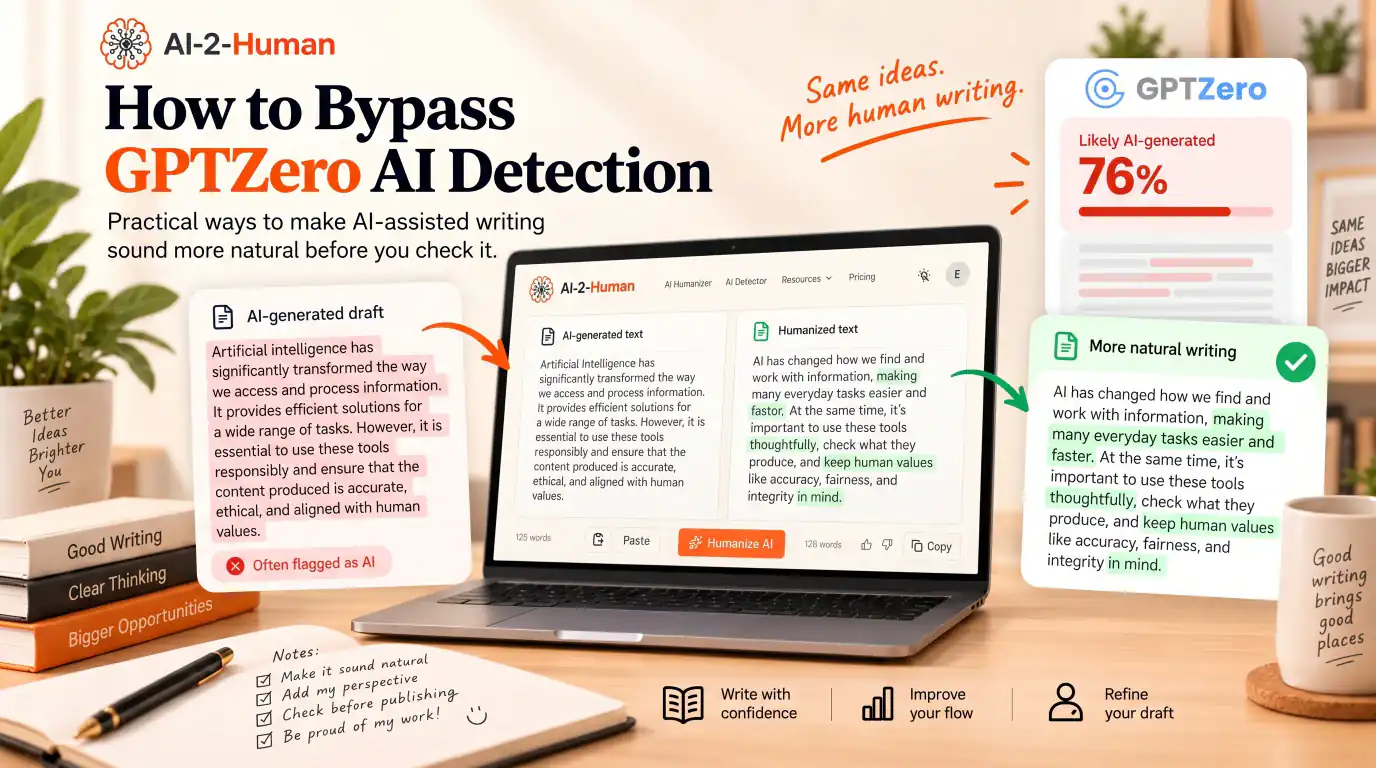
How to Bypass GPTZero AI Detection
Trying to bypass GPTZero AI detection? Start with the writing itself. A generated draft tends to reuse the same sentence shapes, the same transitions and the same level of detail from paragraph to paragraph, and those are exactly the patterns AI-2-Human rewrites: paste your text to get more natural wording, varied sentence structure and a better flow before you check it again. This guide covers what GPTZero currently measures, which edits genuinely improve a draft, and how to use a Humanizer instead of formatting tricks or random synonym swaps.
What is GPTZero AI detection?
GPTZero is an AI text detector. You paste a text or upload a document, and its model estimates how much of that text was written by a machine. Instead of a simple yes or no, it returns one of three classifications: written entirely by a human, written entirely by an AI, or written by a mix of both. Each result also carries a confidence category, from uncertain to highly confident.
The document verdict is not the only output. GPTZero also highlights the individual sentences that contributed most to the classification, which is what makes the result useful for revision: you can see where the model reacted instead of guessing. Read the two levels separately, because they answer different questions.
How does GPTZero detect AI-generated writing?
GPTZero describes an end-to-end deep-learning approach rather than a list of hand-written rules: models trained on text from the web, from education and from a range of language models, followed by a sentence-by-sentence classifier that estimates the probability and confidence that a given sentence was created by AI. GPTZero’s documentation points readers to that technical breakdown as the current description of its system.
GPTZero: how does your AI detection model work?
One widespread claim is worth correcting, because most older guides still repeat it. GPTZero used perplexity and burstiness before autumn 2023, and its documentation states that it no longer uses those measures directly for AI detection since it migrated to a deep-learning architecture. Perplexity describes how predictable a text is word by word, and burstiness describes how much that predictability varies across a document. Both ideas remain good ways to understand why machine-written prose tends to feel smooth and even, but they are no longer the published basis of the classifier.
GPTZero: how do I interpret burstiness or perplexity?
GPTZero also states that it defends against common methods used to bypass AI detection, such as paraphrasing and homoglyph attacks, where letters are replaced with visually similar characters. Its paraphrasing detection is described as a beta feature aimed at text altered with certain AI-paraphrasing and bypasser techniques.
GPTZero: how does GPTZero detect AI paraphrasing and AI bypassers?
Read the scope of that sentence carefully, because it is the most useful thing on this page. A light automatic paraphrase stays close to the original: it keeps the paragraph order, the sentence shapes and the rhythm, so the structure the model reacts to is still there. That is why AI-2-Human rewrites from the meaning outwards, rebuilding sentences, wording and flow instead of exchanging synonyms, and why the result is meant to be reviewed and completed by you before you rely on it.
The exact weights and thresholds of the system are not public, so nobody outside GPTZero can tell you which sentence will be classified and why. What you can control is whether your draft still reads like a first draft that was generated in one pass. That is the part AI-2-Human changes.
Why does AI-generated text get flagged by GPTZero?
A generated draft can look polished while every paragraph does the same job in the same way. These are editing clues rather than a diagnostic checklist: human writers use the same patterns, and a generated passage does not have to contain them. They are still the fastest way to see what needs fixing.
- Repetitive transitions: “Furthermore”, “Moreover” and “Additionally” open sentences without explaining the relationship between the ideas.
- Symmetrical structure: each paragraph announces a point, restates it, then closes on a broad generalisation.
- Uniform rhythm: sentences keep the same length and shape even when the ideas need different emphasis.
- Generic introductions and conclusions: the opening promises a topic, the ending repeats it, and neither commits to a claim.
- Vague claims: “This improves efficiency” replaces an explanation of what improved, for whom and under which conditions.
- Repeated sentence templates: several paragraphs are built from the same grammatical scaffolding with the nouns swapped.
- Excessive signposting: the text announces what it is about to say more often than it says it.
- Missing reasoning: the draft lists facts but never explains why they support the position.
- Generic examples and an overly consistent tone: nothing in the passage sounds specific to your subject or your voice.
These are the writing patterns AI-2-Human is designed to improve. The Humanizer varies sentence structure, reduces repetitive phrasing and smooths the flow of AI-assisted drafts, while you supply the reasoning, the example and the qualification that make the text specific to your work.
If you only have time for one pass, pick the paragraph you like least and write its purpose in the margin. If the best you can write is “sounds relevant”, the paragraph needs a clearer claim or should be removed. That decision improves the draft more than guessing which word the detector disliked.
How to make AI-assisted writing more natural
You can make these edits by hand, or use AI-2-Human to speed up the first rewriting pass. Paste the AI-assisted draft into the Humanizer to improve wording, sentence variation and flow, then review the result and add the reasoning or context only you can provide.
Revise in layers: argument first, evidence second, sentences last. Polishing a paragraph before deciding what it should say makes weak reasoning harder to notice. Keep the original draft so you can compare versions and explain your own choices later.
- 1
Read
Identify the claim and the purpose of every paragraph.
- 2
Humanize
Rework repetitive wording, sentence structure and flow with AI-2-Human.
- 3
Personalize
Add your own reasoning, context and examples.
- 4
Verify
Check every fact, quotation and citation against its source.
- 5
Check
Run the final text through an AI detector before you submit it.
1. Rewrite formulaic passages
Generated prose often reaches for the most generic version of a sentence, because that version fits everywhere and commits to nothing. Replace it with the point you actually want to make, even if the result is shorter or more specific than what a model would have produced. This is the pass AI-2-Human does at scale: it rewrites predictable sentence shapes and repeated wording so that you edit a natural version instead of starting from a blank page.
2. Vary sentence structure naturally
Let the idea decide the length. A short sentence can settle a decision. A longer one can carry the evidence, the condition and the limit. Combine sentences that repeat each other and split the ones holding two unrelated claims. Do not add random errors or force variation just to change how the text looks: readers notice manufactured unevenness faster than they notice uniformity.
3. Remove repetitive transitions
“Furthermore”, “Moreover”, “Additionally” and “It is important to note” usually stand where a real relationship should be. Ask what the link actually is, then write it: a cause, a contrast, a condition, a consequence, a concession. No single word is an automatic trigger, and deleting “in conclusion” does not make a text human. Replacing an empty connector with the relationship it was hiding does.
4. Make claims more specific
Where a claim is broad, name what changes, for whom and under which conditions. “AI technology provides many important benefits for businesses” is hard to disagree with and impossible to check. “For a support team handling hundreds of repeated questions, automated triage can reduce the number of tickets that need manual sorting” says what improves and where it stops applying. Specific writing also reads less like a generated summary, because it contains information the model did not have.
5. Add your own reasoning
After each claim, ask why a reader should believe it, how it works in practice, under which conditions it holds and where it breaks down. Then write the answer. This is the part no rewriting tool can supply: your comparison, your measurement, your reading of the source, your objection. AI-2-Human improves the language around the argument, so that your reasoning is what a reader notices.
6. Add examples and context
Use a real case from your own work, and label an invented teaching example as hypothetical. Context is what makes a general statement checkable: the constraint you were working under, the alternative you rejected, the period you compared. Do not invent experiences or data to create a more personal voice.
7. Review facts and citations
Drafts that started from a language model can carry a citation that does not exist, a real source used for a claim it does not make, or a number that drifted during rewriting. Open every source yourself, confirm the author, title, date and the passage you rely on, then support, qualify or delete the claim before submission.
8. Read the final text as a whole
Check that the document still sounds like you: the same vocabulary, the same level of formality, the same way of introducing a reservation. A patchwork of rewritten paragraphs can read well sentence by sentence and strangely as a whole. Read it once for voice, once for accuracy, and once aloud.
Before and after: from formulaic writing to natural writing
The example below is fictional and editorial. It is not a recorded product output, and no detector score is attached to it, because a score would only describe one measurement on one model at one moment. Imagine a student working out where AI tools fit into their own study routine.
Before
Artificial intelligence is becoming increasingly important in education. Furthermore, AI tools provide many benefits for students. Moreover, these tools can increase productivity and improve learning outcomes. Therefore, students should use AI technology to achieve academic success.
After
AI tools are most useful when they solve a specific problem. A student who has already read the chapter might use one to generate practice questions, then try to answer them without notes. That is a different exercise from asking for the assignment itself: a wrong answer shows exactly which part of the chapter did not stick, while a finished draft can hide the gap until the feedback arrives.
Can AI-2-Human help bypass GPTZero AI detection?
Yes, for the rewriting that matters. AI-2-Human turns formulaic, machine-like prose into writing that reads like a person wrote it: it improves sentence structure, wording, rhythm and repetitive phrasing while keeping your original message at the centre. The patterns it targets are the ones described above.
That distinction is more practical than it sounds. GPTZero says its model shields against paraphrasing and character substitution, which is why word swapping and hidden tricks are a dead end: they leave the structure of the text intact and only change its surface. Rewriting that structure, then adding your own reasoning on top of it, changes the text itself. That is the work a Humanizer can accelerate, and it is why AI-2-Human rewrites from the meaning of your text rather than from a list of replacements.
The workflow stays practical: humanize the draft, read the rewrite, keep what is clearer, and put back anything that matters, such as technical terms, numbers, citations and careful wording like “may” or “in most cases”. Detection models are updated continuously, so the dependable approach is the one that improves the writing. Use AI-2-Human for the first pass, then make the final version genuinely yours.
- 1
Paste your AI-assisted draft
Start with a draft whose ideas you understand.
- 2
Humanize the text with AI-2-Human
Rework repetitive wording, sentence structure and flow.
- 3
Review facts, meaning and citations
Compare the rewrite with your original and your sources.
- 4
Add your own reasoning and examples
Supply the context only you can verify.
- 5
Check the final text with the AI Detector
Use its result as an additional review signal.
- 6
Make any final edits
Refine unclear passages and keep your draft history.
Check your text before you submit or publish it
Humanize, review, detect, then refine where needed. Once the draft has been revised, run it through the AI-2-Human Detector to see how it reads for AI-detection patterns. Its assessment points to the passages that still sound generated, so you know where to look and what to fix. The Detector reports its own reading of the text rather than a copy of GPTZero’s model, which makes it a useful second pass on the same document.
Read the explanation next to the text. Is the flagged passage vague, repetitive or thinly supported? Fix the writing. If it is already precise and appropriate, a new score is not a reason to keep rewriting: at some point you stop improving the draft and start damaging it. Keep your notes and earlier versions so you can show how the work developed.
Common mistakes when trying to bypass GPTZero
- Swapping synonyms without improving the sentence. If the claim is vague, changing its vocabulary leaves it vague.
- Rewriting every sentence mechanically. Uniform rewriting produces a different uniformity.
- Hunting for so-called AI words. A vocabulary list is not a description of how detectors classify text.
- Adding spelling mistakes on purpose. Errors make the work worse and do not make it more human.
- Using invisible characters, odd spacing or formatting tricks. They damage readability and do not improve the writing.
- Deleting accurate terminology to move a score. Precision is usually the part of a text worth protecting.
- Accepting a rewrite without checking it. A small edit can turn a cautious conclusion into a certainty.
- Rewriting good text until it gets worse. If a passage already reads naturally and says what you mean, leave it alone.
- Ignoring factual or citation problems. A well-written unsupported claim is still an unsupported claim.
AI-2-Human improves the writing itself instead of leaning on formatting exploits or damaged text: no hidden characters, no unusual spacing and no deliberate typos.
Can GPTZero be wrong?
Yes, and GPTZero says so itself. Its documentation acknowledges that edge cases exist in both directions, that no AI detector is fully accurate, and that a result should be treated as one element of a wider assessment rather than as a final verdict. It also notes that its classifier performs best on longer texts and on English prose written by adults, and that it can sometimes flag other machine-generated or highly procedural text as AI-written.
GPTZero: what are the limitations of GPTZero’s AI classifier?
Reliability also depends on how much text you give it. GPTZero states that document-level accuracy is higher than paragraph-level, which is higher than sentence-level. A highlighted sentence is therefore a weak signal on its own, and a verdict on a short extract carries less weight than the same verdict on a full document.
Before you submit: a practical checklist
- I understand and can explain every paragraph.
- I removed repetitive or generic AI phrasing.
- Sentence structure varies naturally instead of following one template.
- My claims are specific rather than vague.
- I added reasoning or context where it was missing.
- My examples fit the topic instead of filling space.
- I checked every fact, quotation and citation against its source.
- Any Humanizer rewrite kept the meaning I intended.
- I read the final text from beginning to end.
- I checked the revised version with an AI detector.
Frequently asked questions
GPTZero is an AI text detector. It returns one of three document classifications (written by a human, by AI, or a mix of both) with a confidence category, and highlights the sentences that contributed most to the result.
GPTZero describes an end-to-end deep-learning approach: models trained on human and AI-generated text, followed by a sentence-by-sentence classifier that estimates the probability and confidence that a sentence was created by AI. The exact weights and thresholds are not public.
Work on the writing rather than on tricks. Vary sentence structure, replace empty transitions with real relationships, make vague claims specific, add your own reasoning, verify every fact, and rewrite the passages that still read like a generated first draft. AI-2-Human can handle the first rewriting pass so you start from a more natural version.
Yes, for the rewriting. AI-2-Human rewrites AI-assisted text so it reads more naturally, improving sentence structure, wording, rhythm and repetitive phrasing while keeping your meaning at the centre. That removes the formulaic patterns detectors react to, and gives you a stronger draft to review, complete and make your own.
Try the AI Humanizer →Text produced by ChatGPT falls inside what GPTZero is built to classify, and the company states that it updates its system as new models appear, including GPT-4, GPT-5, Gemini, LLaMA and Claude. That does not mean every ChatGPT passage is flagged, or that a flagged passage proves that ChatGPT was used.
GPTZero offers paraphrasing detection as a beta feature for text altered with certain AI-paraphrasing and bypasser techniques, and says its model shields against paraphrasing and homoglyph attacks. A light paraphrase keeps the paragraph order, sentence shapes and rhythm that triggered the flag, which is why AI-2-Human rebuilds the sentences themselves instead of trading words.
No. GPTZero states that as of autumn 2023 it no longer uses perplexity and burstiness for AI detection, because it moved to a deep-learning architecture. Both concepts still explain why generated prose can feel smooth and even, but they are not the published basis of the current classifier.
Yes. GPTZero acknowledges edge cases in both directions and recommends treating its result as one part of a wider assessment rather than a final decision. Accuracy is also higher on longer documents than on single sentences, and the classifier is trained mainly on English prose written by adults.
A classifier can misread human writing, particularly short extracts, procedural or highly formulaic text, and writing that sits far from its training data. GPTZero reports keeping its false positive rate at no more than 1% for AI versus human text and advises checking the sentence highlights rather than treating the document verdict as final.
Not on its own, and that is the useful part. Synonym swapping and character substitution change the surface of a text while leaving its structure in place, which is why GPTZero says its model defends against both. The edits that change the writing are structural: sentence variety, real transitions, specific claims and your own reasoning.
It is a sensible order. Humanize the draft so the writing itself is less formulaic, review the rewrite, add the context only you can supply, then check the text. You will spend your time fixing real problems instead of chasing individual words.
Humanize AI text →Yes, as a second review pass. The AI-2-Human Detector highlights the passages that still read as generated so you can inspect them in context. It reports its own assessment rather than GPTZero’s model, so treat the two results as separate signals about the same text.
Check with the AI Detector →Sources & editorial notes
- GPTZero: AI Detection Technology
- GPTZero: how does your AI detection model work?
- GPTZero: how does GPTZero detect AI paraphrasing and AI bypassers?
- GPTZero: how do I interpret burstiness or perplexity?
- GPTZero: what are the limitations of GPTZero’s AI classifier?
- GPTZero: how do I use GPTZero?
AI-2-Human is not affiliated with or endorsed by GPTZero. GPTZero product documentation was reviewed on September 20, 2026; detection capabilities can change.
Updated